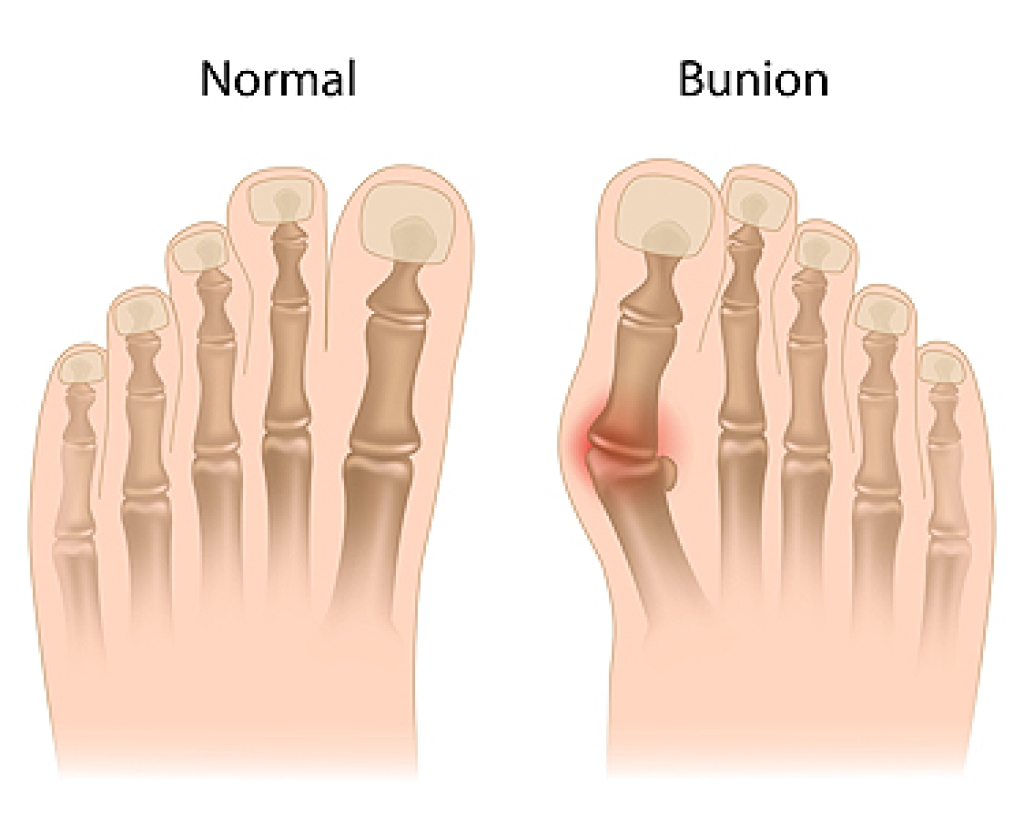
What to Know About Bunions

A bunion, or hallux valgus, is a common foot ailment where a bony bump occurs on the joint of a big toe when bones on the top part of the foot move out of place. The pressure causes the tip of the big toe to be pulled toward the smaller toes and forces the joint to remain stuck. Bunions can develop from wearing tight or narrow shoes or having an abnormal foot shape, a pre-existing medical condition (like arthritis), or a foot deformity. Bunionettes, or smaller bunions, might form on the joint of a smaller toe.  Elderly people and women are more apt to get bunions. They can occur on one or both feet. Bunions can be painful, the joint might get stiff and swollen, and the skin may get sore and red. Prolonged standing might exacerbate the pain of a bunion. If left untreated, bunions can get worse over time, and it might become difficult to walk. Bunion pads, well-fitted shoes, or toe spacers might help. In severe cases, bunion surgery – a bunionectomy – might be called for. If you have a bunion, it is suggested that you see a podiatrist who can recommend the appropriate treatment for you.

If you are suffering from bunion pain, contact James P. Huish, DPM of Arizona. Our doctors can provide the care you need to keep you pain-free and on your feet.

What Is a Bunion?

Bunions are painful bony bumps that usually develop on the inside of the foot at the joint of the big toe. As the deformity increases over time, it may become painful to walk and wear shoes. Women are more likely to exacerbate existing bunions since they often wear tight, narrow shoes that shift their toes together. Bunion pain can be relieved by wearing wider shoes with enough room for the toes.

Causes

  • Genetics – some people inherit feet that are more prone to bunion development
  • Inflammatory Conditions - rheumatoid arthritis and polio may cause bunion development

Symptoms

  • Redness and inflammation
  • Pain and tenderness
  • Callus or corns on the bump
  • Restricted motion in the big toe

In order to diagnose your bunion, your podiatrist may ask about your medical history, symptoms, and general health. Your doctor might also order an x-ray to take a closer look at your feet. Nonsurgical treatment options include orthotics, padding, icing, changes in footwear, and medication. If nonsurgical treatments don’t alleviate your bunion pain, surgery may be necessary.

If you have any questions, please feel free to contact our office located in Safford and Sierra Vista, AZ . We offer the newest diagnostic and treatment technologies for all your foot care needs.


Read more about Bunions

Plantar Fasciitis in Cyclists

Plantar fasciitis is among some of the most common conditions that negatively impact the feet. The condition occurs when the plantar fascia, the band of tissue that runs underneath the foot from the heel to the toes, becomes strained and inflamed. Some individuals might be more at risk than others of developing plantar fasciitis or getting worse symptoms of the condition. Cyclists and bikers fall into this category. Some cyclists incorrectly position their feet in the pedals when cycling, which can cause plantar fasciitis complications. Specifically, the feet are supposed to point straight when in the pedals. Generally speaking, the toes ought not point outward or inward, as this can put strain on the foot, potentially aggravating plantar fasciitis. Additionally, biking with a saddle that is positioned at an incorrect height can also increase the risk of developing plantar fasciitis. Oftentimes, the saddle is positioned far too low, which can prohibit the legs from fully extending when cycling. If you are a cyclist, it might be a good idea to contact a podiatrist to help you determine how to avoid developing or aggravating plantar fasciitis.

Plantar fasciitis can be very painful and inconvenient. If you are experiencing heel pain or symptoms of plantar fasciitis, contact James P. Huish, DPM  from Arizona. Our doctors can provide the care you need to keep you pain-free and on your feet.

What Is Plantar Fasciitis?

Plantar fasciitis is the inflammation of the thick band of tissue that runs along the bottom of your foot, known as the plantar fascia, and causes mild to severe heel pain.

What Causes Plantar Fasciitis?

  • Excessive running
  • Non-supportive shoes
  • Overpronation
  • Repeated stretching and tearing of the plantar fascia

How Can It Be Treated?

  • Conservative measures – anti-inflammatories, ice packs, stretching exercises, physical therapy, orthotic devices
  • Shockwave therapy – sound waves are sent to the affected area to facilitate healing and are usually used for chronic cases of plantar fasciitis
  • Surgery – usually only used as a last resort when all else fails. The plantar fascia can be surgically detached from the heel

While very treatable, plantar fasciitis is definitely not something that should be ignored. Especially in severe cases, speaking to your doctor right away is highly recommended to avoid complications and severe heel pain. Your podiatrist can work with you to provide the appropriate treatment options tailored to your condition.

If you have any questions, please feel free to contact our office located in Safford and Sierra Vista, AZ . We offer the newest diagnostic and treatment technologies for all your foot care needs.

Read more about Plantar Fasciitis

What Does an Ankle Sprain Feel Like?

Spraining your ankle is certainly not a pleasant experience. Not only can ankle sprains be painful, they can also take weeks to months to fully heal, depending on the severity of the sprain. Ankle sprains occur when the ligaments surrounding the ankle bones and joints become torn, stressed, or otherwise strained. If you suspect that you might have sprained your ankle, here are several symptoms that some patients might experience with an ankle sprain. First, an individual might be unable to put their weight on the affected ankle, and be incapable of walking or running. If you have an ankle sprain, you might also notice some degree of skin discoloration on the affected area or perhaps some bruising. You might even experience different sensations in the ankle, such as a feeling of swelling, tenderness, or stiffness. Ankle sprains happen to many different people, so if you think that you might be one of them, contact a podiatrist. Your podiatrist will be able to help you remedy the problem. 

Ankle sprains are common but need immediate attention. If you need your feet checked, contact James P. Huish, DPM from Arizona. Our doctors can provide the care you need to keep you pain-free and on your feet.

How Does an Ankle Sprain Occur?

Ankle sprains take place when the ligaments in your ankle are torn or stretched beyond their limits. There are multiple ways that the ankle can become injured, including twisting or rolling over onto your ankle, putting undue stress on it, or causing trauma to the ankle itself.

What Are the Symptoms?

  • Mild to moderate bruising
  • Limited mobility
  • Swelling
  • Discoloration of the skin (depending on severity)

Preventing a Sprain

  • Wearing appropriate shoes for the occasion
  • Stretching before exercises and sports
  • Knowing your limits

Treatment of a Sprain

Treatment of a sprain depends on the severity.  Many times, people are told to rest and remain off their feet completely, while others are given an air cast. If the sprain is very severe, surgery may be required.

If you have suffered an ankle sprain previously, you may want to consider additional support such as a brace and regular exercises to strengthen the ankle.

If you have any questions please feel free to contact our office located in Safford and Sierra Vista, AZ . We offer the newest diagnostic tools and technology to treat your foot and ankle needs.

Read more about Ankle Sprains

Morton’s Neuroma in Cycling

If you feel pain or numbness near the ball of your foot, under your toes, you may have a Morton’s neuroma. People sometimes describe this as feeling like there is a pebble or rock under their toes. Others describe it as a burning sensation, a sharp pain, or numbness in this area of their foot. A Morton’s neuroma is a thickening of the tissue around the nerves leading to the toes. Pain is usually felt between the 3rd and 4th toe or the ball of the foot between the 2nd and 3rd toes. It is a benign condition. A Morton’s neuroma can happen from wearing tight or high-heeled shoes. In cycling, shoes are usually lower volume, and these could pinch the toes together for prolonged periods depending on the length of your ride. This puts cyclists at a higher risk for this problem. Other causes of Morton’s neuroma include foot abnormalities, such as bunions, hammertoes, or flat feet. It can also be caused by repeated trauma from the feet pounding on pavement like in running, and as related to cycling when the foot tilts as it connects with the pedal of the bike. Make sure your cycling shoes are well-fitted. The toe box should be wide enough to allow toes to move freely and with a proper tilt. A wedge can be used to reduce pressure under the first two toes and help to relieve discomfort. If you are a cyclist and are experiencing the kind of pain described above, consider seeing a podiatrist for proper diagnosis and treatment that best suits you.

Ankle and foot injuries are common among athletes and in many sports. They can be caused by several problems and may be potentially serious. If you are feeling pain or think you were injured in a sporting event or when exercising, consult with James P. Huish, DPM from Arizona. Our doctors will assess your condition and provide you with quality foot and ankle treatment.

Common Injuries

The most common injuries that occur in sporting activities include:

  • Achilles Tendonitis
  • Achilles Tendon Rupture
  • Ankle Sprains
  • Broken Foot
  • Plantar Fasciitis
  • Stress Fractures
  • Turf Toe

Symptoms

Symptoms vary depending upon the injury and in some cases, there may be no symptoms at all. However, in most cases, some form of symptom is experienced. Pain, aching, burning, bruising, tenderness, tightness or stiffness, sensation loss, difficulty moving, and swelling are the most common symptoms.

Treatment

Just as symptoms vary depending upon the injury, so do treatment options. A common treatment method is known as the RICE method. This method involves rest, applying ice, compression and elevating the afflicted foot or ankle. If the injury appears to be more serious, surgery might be required, such as arthroscopic or reconstructive surgery. Lastly, rehabilitation or therapy might be needed to gain full functionality in the afflicted area. Any discomfort experienced by an athlete must be evaluated by a licensed, reputable medical professional.  

If you have any questions please contact our office located in Safford and Sierra Vista, AZ . We offer the newest diagnostic and treatment technologies for all your foot and ankle needs.

Read more about Sports Related Foot And Ankle Injuries

Are You Suffering From Ingrown Toenails?

If left untreated, an ingrown toenail can lead to more serious concerns, such as an infection. Knowing proper nail care can help in the prevention of an ingrown toenail. Give us a call, and get treated!

Connect With Us

scroll-to-top